Arizona Genetics Core

RRID:SCR_012429

Bioanalyzer

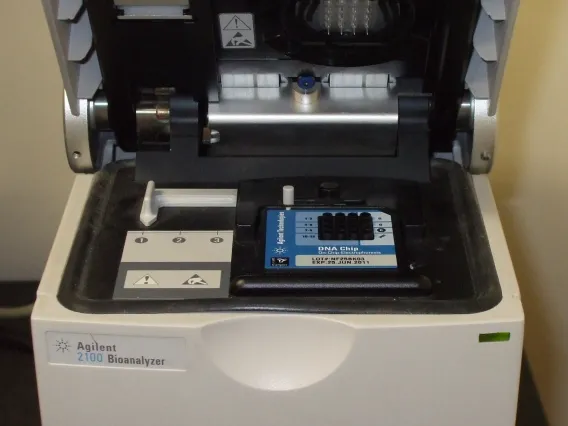
The Agilent Bioanalyzer 2100 offers quick and convenient sizing and quantification analysis for DNA or RNA.

General Information


Sample Input

Agilent High Sensitivity DNA Kit: 11 samples/chip, ≥2µL of each sample prepared in deionized water in .2mL strip-tubes.

Agilent RNA 6000 Pico Kit: 11 samples/chip, ≥2µL of each sample prepared in deionized water in .2mL strip-tubes.

Agilent RNA 6000 Nano Kit: 12 samples/chip, ≥2µL of each sample prepared in deionized water in .2mL strip-tubes.

Expected Results

High Sensitivity DNA Chip: DNA Concentration 5-500pg/µL, DNA sizing 50-7000 bp

RNA 6000 Pico Chip: RNA Concentration Qualitative metrics: RNA Integrity Number (RIN)
Quantitative range = 50-5000pg/µL (Total RNA Assay), 250-5000pg/µL (mRNA Assay)

RNA 6000 Nano Chip: RNA Concentration Qualitative metrics: RNA Integrity Number (RIN)
Quantitative range: 25-500ng/µL (Total RNA Assay), 25-250ng/µL (mRNA Assay)

Details


Sample Preparation Details

AZGC offers analysis with the following chips:

High Sensitivity DNA Chip: For the separation, sizing and quantification of low concentrated dsDNA samples from 50-7000 bp. Your samples should be diluted to 5-500pg/µL, despite what it says on the website. Smaller concentrations may not show up on the chip.

RNA 6000 Pico Chip: Each chip can accommodate 11 samples and uses 2µL of each sample. Prepare your samples in RNase free water. RNA must be submitted in 0.2mL tubes at no greater than 5µL volume. Total RNA in each sample must be between 200-500pg/µL and mRNA concentration must be between 500-5000pg/µL. If your sample is more concentrated please dilute with RNAse free water. This process will render the RNA unusable for downstream applications- please provide only the volume required for this QC.

RNA 6000 Nano Chip: Each chip can accommodate 12 samples and uses 2µL of each sample. Prepare your samples in RNase free water. RNA must be submitted in 0.2mL tubes at no greater than 5µL volume.
Total RNA in each sample must be between 5-500ng/µL and mRNA concentration must be between 25-250ng/µL. If your sample is more concentrated please dilute with RNase free water. This process will render the RNA unusable for downstream applications- please provide only the volume required for this QC.

Learn more information on each chip's specifications

Quantification with the Nanodrop instrument can be very inaccurate. Qubit results are generally much more accurate.

Workflow

If you are submitting RNA, it is recommended that you deliver your samples to the AZGC drop-off freezer inside Keating Rm 106D, please do not submit RNA to the drop-off freezer in LSS.

To submit your samples please log into iLab Operations Software and select Request Services. You should receive results within 2 business days of sample receipt by AZGC.

Price

See AZGC current pricing

Academic (UA): $90.00 | Academic (non-UA): $108.00 | Industry: $135.00 Unit:Chip

*Note DNA High Sensitivity Chips are subject to a $25 supplemental reagent fee

Turnaround Time

This workflow takes approximately 1 hour per chip. Turnaround time on Bioanalyzer submissions is within 2 days of samples being physically received by AZGC.

Related Services

RNA Extraction

DNA Extraction


Additional Information

The Agilent 2100 Bioanalyzer uses chips that are designed for DNA and RNA analysis. The chips are composed of microchannels that separate the nucleic acid fragments by size as they are electrophoretically moved through the gel matrix.

RNA Chips- This process will render the RNA unusable for downstream applications- please provide only the volume required for this QC.

Image
agilent
Service
Contact
Location

Cell Line Authentication

Cell Line Authentication

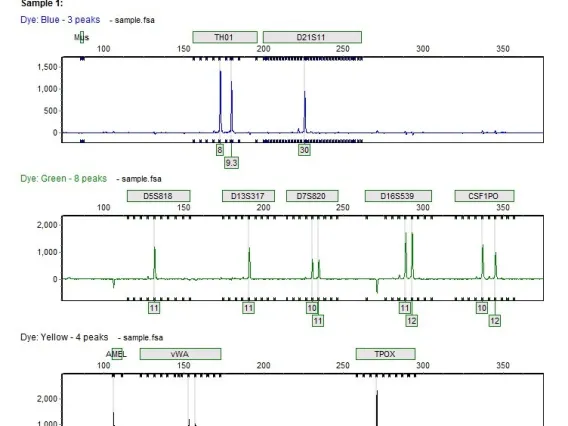
Contamination and misidentification of commercial cell lines can jeopardize your research. Cell line authentication can ensure the quality of your work by providing a DNA fingerprint for each of your human cell lines and tissue bank specimens.

General Information


Sample Input

AZGC accepts a variety of sample types, including genomic DNA, cell pellets, or tissue/tumor pieces. Samples requiring DNA Extraction will incur associated extraction charges. Please note - currently we only are able to perform human cell line authentication.

Expected Results

AZGC provides autosomal STR profiles suitable for verification using reference databases (such as ATCCDSMZJCRB and others) or we can internally validate samples unique to your lab. We provide researchers with PDF reports and if requested- sample profiles (allelic values) and electropherogram trace data.

Details

Sample Preparation Details

Genomic DNA should be diluted to 5ng/µL in Low TE or HPLC water. 20µL (100ng) of genomic DNA is sufficient. If you use Nanodrop to quantify your samples please do not dilute your DNA prior to submission.

Cell pellets should contain at least 1x10⁶ cells and are best stored in Lysis Buffer.

Tissue and tumor pieces should be approximately 5mg or the size of a small pea. If you have limited source tissue or expect low sample yield please contact AZGC to discuss the best DNA extraction method.

An electronic submission must be created in iLab Operations Software.

Samples may be shipped to:
AZGC c/o Stacy Sotak
1657 E Helen St Rm. 106
Tucson, AZ 85721

Workflow

Testing details: Promega PowerPlex16HS Assay: 15 Autosomal Loci, X/Y
Random match probability approx. 1 in 1.83x10¹⁷
 

Price

See AZGC current pricing

Academic (UA): $65.00 | Academic (non-UA): $78.00 | Industry: $97.50 | Unit: Sample

Turnaround Time

5-7 working days

Related Services

DNA Extraction from cell pellets, tumors, or tissue

Samples are maintained in the lab for 1 month after results are returned to the user, unless other/long-term storage has been requested.

Additional Information

We recommend authentication upon receipt or establishment of a new cell line/specimen, after several passages, and periodically during the life of the research line.

Sample profiles may be compared to other cell lines in this submission or from previous submissions from the same lab group free of additional charge.

Sample profile comparisons to source databases or identification of an unknown genotype or cell line may incur additional analysis charges.

Image
Cell Auth sample
Service
Contact
Location

Transgenic Mouse Genotyping

The AZGC provides Transgenic Mouse Genotyping Services. Select your region of interest (see full below), or we can design a custom assay to genotype your specific line. New assays will be subject to a one-time consumable fee. Please contact our core for additional details.

General Information


Sample Input

We provide barcoded collection tubes pre-filled with extraction buffer. Simply add 2-4mm of tail tissue and return to the AZGC. Other tissues can be utilized, please email for details.

Expected Results

Depending on the locus, the AZGC utilizes a variety of methods to generate data on your samples, including fragment analysis and gel electrophoresis.

Note- We can return the remainder of your sample (as crude extract) after genotyping upon request. Samples not returned to researchers will be maintained in our lab for 90 days after genotyping. After 90 days the samples will be destroyed in keeping with our SOPs.

Details

Sample Preparation Details

Sample collection tubes containing extraction buffer are provided. Contact AZGC to request by mail or pick up tubes from the AZGC submission freezer- Keating building 1st floor. Simply add 2-4mm of tail tissue to the tube and return to:
           Priscilla Jayassi/ AZGC
           1657 E Helen St Rm 106
           Tucson, AZ 85721
Samples with STE buffer can be shipped at ambient temperature. Local researchers may drop off samples in person Monday-Friday 9am-5pm. Samples may be dropped off at Keating/BIO5 1st Floor AZGC Submission Freezer- Room 106D.

Other tissues can be utilized, please email for details.

Workflow

How to get started with your sample submission:

 •  Log into iLab Operations Software and select Request Services.

Video Tutorial

Price

View AZGC Current Pricing

Academic (UA): $5.00 | Academic (non-UA): $6.00 | Industry:  $7.50 | Unit: Assay

Turnaround Time

5-7  business days

Related Services

Quick and Easy DNA Extraction - cost-effective and fast extraction

Additional Information

The price listed above is per assay. Individual samples may be run for multiple assays. Does not include the price for DNA extraction.

Service
Location

Nanostring nCounter Gene Expression Analysis

AZCG offers gene expression services using the NanoString nCounter® Analysis System. This system uses molecular "barcodes" and single-molecule imaging to profile up to 800 mRNAs, microRNAs targets simultaneously with high sensitivity and precision, without any reverse transcription or amplification.

General Information


Sample Input

Gene Expression, miRNA and miRGE Assasys:
        •  100ng purified total RNA or 300ng degraded


 AZGC offers a variety of extraction services for most sample types, please inquire for details and pricing.

Expected Results

Gene Expression
Limit of Detection:
        •  0.5fM spike-in control (~1 copy per cell); 90% of the time
Fold-change Sensitivity:
        •  >1.5 fold (>5 copies per cell)
        •  >2 fold change (>1 copy per cell)
miRNA Assay
Limit of Detection:
        •  ≤ 0.5fM (~10 copies per cell)
Fold-change Sensitivity:
        • > 2 fold change
 

Details

Sample Preparation Details

Varies, please inquire.

Workflow

A variety of pre-designed panels are available for off-the-shelf use. Each cartridge can run up to 12 samples, and most panel kits are sold with chemistry for 12, 24, 48 or 96 samples (Custom Panels start at 48 samples). For a complete list of the number of samples and specific genes covered by each panel, please visit the following links: Nanostring website
 
Custom CodeSets
For ultimate flexibility, you can work with NanoString directly (consultation is free of charge) to design a custom Gene Expression or Copy Number Variation code set tailored exactly to your research needs. This is especially useful for organisms that don't already have pre-built panels, hard-to-target sequences, and splice variation and fusion transcript detection. The custom CodeSet design process begins by selecting a list of targets and submitting them to NanoString. Once the design is approved by you, their Manufacturing Group will assemble your CodeSet, perform extensive quality control testing, and ship all components directly to AZGC for processing. Custom CodeSet pricing is matrix based, with the price per data point declining with increasing numbers of genes and numbers of samples assayed.
 

Price

Academic (UA): $575.00 | Academic(non-UA): $690.00 | Industry: $862.50 | Unit: Cartridge

Note- Cost per Cartridge does not include QC, additional labor or NanoString Code Sets. Reagents must be purchased separately. Please inquire for more details.

Turnaround Time

Depends on assay type and sample quantity, please inquire.

Related Services

Sample Prep and QC

Service
Location

Biomek FX/Biomek NX

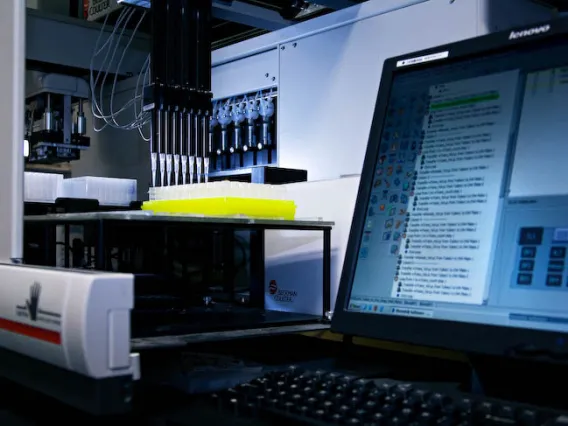
Automated Sample handling is performed with our BioMek FX and NX Robots. These liquid handling platforms enable high throughput sample plating, dilution, and other manipulations. AZGC uses these platforms for sample handling in many of our laboratory workflows.

Image
BiomekFX
Equipment
Location

NanoString nCounter System

Arizona Genetics Core offers gene expression services using the NanoString nCounter® Analysis System. This system uses molecular "barcodes" and single-molecule imaging to profile up to 800 mRNAs or microRNAs targets simultaneously with high sensitivity and precision, without any reverse transcription or amplification.

Image
Nanostring instrument
Equipment
Location

Nanodrop

Simple, rapid, accurate quantification and qualification of DNA and RNA

"Quickly quantify DNA, RNA, and protein from only 1–2 µL of sample with Thermo Scientific NanoDrop Spectrophotometers. Our pioneering sample-retention technology has evolved across the full spectrum to bring you more knowledge about your sample, so that you can save days of troubleshooting and accelerate your research.

Simply pipet a single drop of your DNA, RNA, or protein sample on the pedestal and pull down the arm. No cuvettes or capillaries are needed and the results appear in seconds."

Text Credit:https://www.thermofisher.com/us/en/home/industrial/spectroscopy-element…


Note- this instrument is available for use in Keating106D without a reservation. There is no fee to use the instrument.

Image
Nanodrop Instrument
Equipment
Contact
Location

Covaris Ultrasonicator

"Covaris Adaptive Focused Acoustics (AFA) technology is firmly established as the fragmentation method of choice for NGS, and Covaris continues to innovate the tools required to shear DNA and RNA without GC bias or thermal damage.
The Covaris AFA process is conducted under isothermal conditions, ensuring the integrity of the nucleic acid sample is maintained and providing high recovery of double-stranded DNA during the shearing process.
Combined with the specifically engineered AFA Tubes it is possible to precisely and accurately fragment DNA and RNA to the 100 – 1500bp range (microTUBE), or 2 – 5kb range (miniTUBE)."

Text Credit:https://www.covaris.com/dna-rna-shearing-for-ngs/


Image
Covaris S2 instrument

AZGC uses Covaris Ultrasonicator to shear genomic DNA prior to DNA Library Prep Protocols.

Equipment
Location

Illumina NextSeq550

The Illumina NextSeq550 is used for the generation of high-throughput sequencing data.

Applications include:

  • Whole Genome Sequencing (Shotgun/de novo)
  • Metagenome Analysis
  • CHiPseq
  • miRNA profiling
  • Exome Sequencing
  • RNASeq (transcriptome sequencing)
  • Single Cell Sequencing
  • Other supported and custom protocols (please inquire)
Image
NextSEq500

Image credit: Illumina.com

Equipment
Location