Arizona Genetics Core

RRID:SCR_012429

Sanger Sequencing

AZGC offers high quality and fast turnaround fully automated DNA sequencing on multiple Applied Biosystems 3730 DNA Analyzers.

General Information


Sample Input

Samples can be submitted for low volume (tubes) or high volume (96-well plates) sequencing.

Accepted sample types include PCR product, plasmid DNA, phage, or BACs, cosmids and single-stranded DNA.

Expected Results

Users of this service can expect up to 600 bases of high quality Phred scores per read.

Data can be downloaded directly from your project in iLab Operations Software.

Details


Sample Preparation Details

Please review our Sequencing FAQ to prepare your submission and template DNA according to the guidelines.

Accepted sample types include PCR product, plasmid DNA, phage, or BACs, cosmids and single-stranded DNA.

Provide your own sequencing primer or use our standard universal primers at no extra charge. 


Samples should be eluted in (MilliQ) water. Minimum volume required:
     8µL of template per reaction
     5µL of primer per reaction

Low Volume (tube) sequencing should be submitted in 1.5mL snap-cap tubes. Sample and primer must be submitted in separate tubes.
*Note: If you have more than 29 sequencing reactions it will be more cost effective to use the High Volume (plate) sequencing workflow.

High Volume sequencing should be submitted in a 96-well v-bottom plate.

PCR products should be prepared with commercially available PCR cleanup kits and eluted in (MilliQ) water to remove excess primers, nucleotides, and buffers.

Automated sample cleanup, quantification, and normalization service is available for High-volume (96-well plate) sequencing submissions - simply select these options in your iLab project request.

Workflow

Log into the AZGC's iLab landing page and select Request Services.

Video tutorial for High Volume Sequencing Request

*Drop off your sequencing submission in the freezer outside Keating 106, in Life Sciences South Rm 205 or by sending to

AZGC Attn: Sequencing
1657 E Helen St Rm 106
Tucson AZ 85721

Users of this service can expect 600 bases or greater of high quality Phred scores per read.

View our Sequencing FAQ page for tips about what can cause messy or degraded sequence data.


Price

Low Volume Single Tube Sequencing-

Academic (UA): $6.25 | Academic (non-UA): $7.50 | Industry: $9.38 | Unit: Reaction

High Volume 96-well Plate Sequencing-

Academic (UA): $195.00 | Academic (non-UA): $234.00 | Industry: $292.50 | Unit: 96-Well Plate

Turnaround Time

2-3 working days

Related Services

Please visit our Pricing page

PCR Clean Up and Quantification (available for whole plate only) for High-Volume Sequencing.

Additional Information

If you are submitting more than 30 samples (or 30 total reactions) it will be cost-effective to order High Volume Plate Sequencing. If you have fewer than 29 reactions it will be more cost-effective to submit these as separate tubes for Low Volume Sequencing.
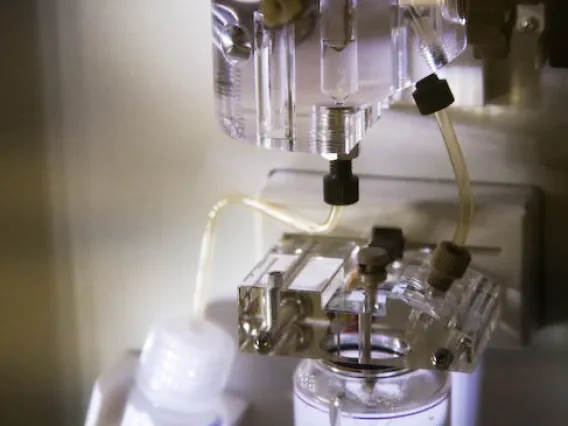
Image
AB3730
Service
Location

Real Time PCR ABI 7900/7300

The following instruments must be scheduled using iLabOperations Software. Please log in or create an account. Instructions on how to reserve time in iLab Operations as well as initiate your usage on the machine are linked below.

Real-Time PCR Cyclers - 
ABI-7300 Keating Building - Schedule this instrument
ABI-7900 Keating Building - Schedule this instrument
ABI-7300 Life Sciences South - Schedule this instrument

If you prefer AZGC specialists perform your real-time PCR or qPCR experiment as a service please reach out to discuss your project with our core. Email: azgc@arizona.edu
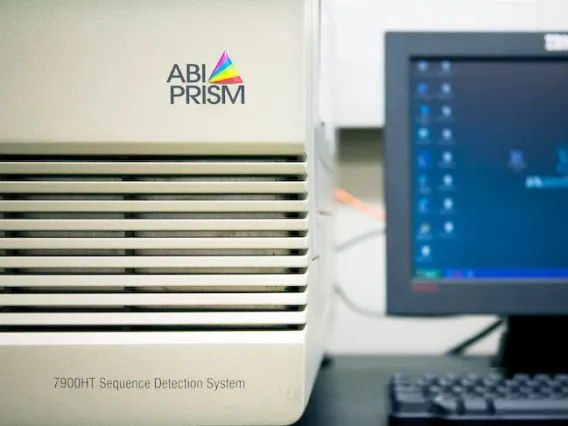
 

Image
RT PCR AB 7900
Equipment
Contact
Location

SNP Genotyping - Mass Array

In addition to Real-Time PCR methods, AZGC offers SNP genotyping on the Agena Bioscience MassARRAY® MALDI-TOF instrument. Using this technology we can multiplex SNPs for up to 36 loci.

General Information


Sample Input

Each reaction requires 1µL of 10ng/µL DNA.

The DNA can be submitted in 96-well or 384-well plates with at least 2 open wells for negative controls

Expected Results

Genotypes are determined through ratio analysis of the MALDI-TOF mass spectrometer.

Details


Sample Preparation Details

  • The DNA samples should be eluted in RNase free or HPLC water. The instrument is very sensitive to salt, so please avoid TE buffer.
  • AZGC can extract and prepare your samples for SNP genotyping.
  • The instrument utilizes 384-well plate format.
  • The DNA can be submitted in 96-well or 384-well plates with at least 2 open wells per every 384 for negative controls.
  • Each reaction requires 1µL of 10ng/µL DNA. It is best if 260/280 ratio is between 1.7 and 2.0.

Workflow

Contact AZGC to discuss SNPs of interest and multiplex design

Multiplex Design Information: This instrument can perform up to a 36-plex, but we typically achieve between 25 and 30 loci. To optimize the largest multiplex possible, it is best to provide 40-50 loci with specific notes about their relative importance. Provide the SNP ID (rs#) and the sequence. Within the sequence, the SNP should be denoted in brackets (i.e. [G/A]), with 100-200 bases of flanking sequence on either side. Tri-allelic SNPs are also detectable. Multiplex PCR assays target ~100bp amplicons containing SNPs of interest.

If there are other known polymorphisms within the sequence please denote them as 'X' so we can design the primers around them. There cannot be polymorphisms bracketing the SNP of interest within 20bp; however, if there is a polymorphism upstream of the SNP of interest, we can design the primer on the antisense strand.

Three primers are utilized per SNP, two for amplification and one for the extension reaction. Primers are unlabeled and usually 15-25 bp in length.

Price

Inquire for quote

See AZGC Current Pricing


Turnaround Time

Varies

Related Services

DNA Extraction
Real Time PCR (alternative SNP genotyping platform)

Additional Information

The price listed above is per 96-well or 384-well plate. If multiplexed at 30 SNPs cost ~ $0.20 per SNP

Primers are not included in the above pricing. These typically run ~$16/SNP.

For more information about the Agena Bioscience MassARRAY® system, please visit our FAQ page or go to http://agenabio.com/

Image
Sequenom
Service

Fragment Analysis

Fragment Analysis

Arizona Genetics Core offers Fragment Analysis services with our two ABI3730 DNA Analyzers. The 3730 uses capillary electrophoresis to separate fluorescently labeled DNA fragments.

General Information


Sample Input

Fluorescently labeled DNA fragments (i.e. labeled PCR Products)

Samples can be submitted in 4-Dye or 5-Dye format, simply upload your sample information in iLab Service Request Form

Expected Results

Data is returned in .fsa file format ready for analysis with Applied Biosystems GeneMapper or compatible software. Applications of fragment analysis include Microsatellite Analysis, Genotyping and Mutation Detection.

Details


Sample Preparation Details

Samples should be submitted in strip tubes or 96-well v-bottom plates in column format and will be run at a dilution specified by the customer- default is 1:50.

Compatible dye sets:
     4-Dye: FAM, HEX, NED (internal Size-Standard ROX)
     5-Dye: FAM, VIC, NED, PET (internal Size-Standard Liz)

Workflow

Log into iLab operations software and select Request Services

Video Tutorial for Fragment Analysis request

AZGC uses an internal Size Standard - GS500LIZ or GS500ROX and conducts Post Processing and QC steps prior to release of data.

Data is returned to the user's iLab Project as a zipped folder

Price

View Current AZGC Pricing

Academic (UA): $1.75 | Academic (non-UA): $2.10| Industry: $2.63
Unit: Sample

Turnaround Time

2 business days. Please note cut-off time for sample receipt is 2pm. Otherwise, they will be added to the next day's queue.

Related Services

PCR

Additional Information

Reactions may be pooled to facilitate multiplexing.

Image
Technician views computer screens of fragment analysis data
Service
Contact
Location