Functional Genomics Core

RRID:SCR_023433

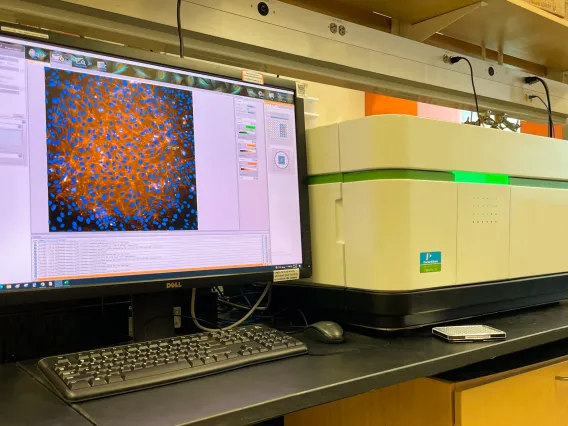
Operetta CLS - high-content analysis microscope imaging system

The Operetta CLS high-content analysis system has all the speed, sensitivity and resolution you need to characterize fine sub-cellular details . The Operetta is designed for fully-automated high-capacity, quantitative cellular analysis of fixed or live cells. It contains the highly sensitive sCMOS camera that provides a large field of view and high resolution image capture. The Operetta's Harmony software lets you find even subtle phenotypic changes.
Features:

  •     Objectives
    • 5x Air Objective: NA 0.16, WD 12.1 mm (field of view: approx. 2583 μm x 2583 μm)
    • 10x Air Objective: NA 0.3, WD 5.2 mm (field of view: approx. 1292 μm x1292 μm)
    • 20x Air Objective: NA 0.4, WD 8.28 mm (field of view: approx. 646 μm x 646 μm)
    • 20x Water Immersion Objective: NA 1.0, WD 1.7 mm (field of view: approx. 646 μm x 646 μm)
    • 40x Water Immersion Objective: NA 1.1, WD 0.62 mm (field of view: approx. 323 μm x 323 μm)
    • 63x Water Immersion Objective: NA 1.15, WD 0.6 mm (field of view: approx. 205 μm x 205 μm)
  • 4.7Mpx sCMOS camera (2160x2160), 16 bit resolution, 6.5um pixel size
  • Motorized 6 position objective turret with 3 air and 3 water immersion objectives
  • High resolution, linear drive scanning stage
  • High speed precision laser autofocus
  • Transmitted light unit (LED: 740nm) for Brightfield and Digital Phase Contrast imaging
  • Emission filters:
    • 430-500 nm
    • 470-515 nm
    • 500-550 nm
    • 525-580 nm
    • 570-650 nm
    • 655-760 nm
  • Spinning Disk enables optical sectioning
  • Confocal imaging improves optical resolution and contrast
  • Pinhole disk reduces out-of-focus light
  • LED light engine equipped with 8 high power LEDs with the following excitation wavelengths:
    • 355-385 nm
    • 390-420 nm
    • 435-460 nm
    • 460-490 nm
    • 490-515 nm
    • 530-560 nm
    • 615-645 nm
    • 650-675 nm
  • Environmental Controls for live cell experiments:
    • Temperature can be controlled between 37°C - 42°C
    • CO2 concentration can be controlled between 1-10%

Tips & tools for data collection and interpretation:

Revvity’s Harmony software is used to acquire images on the Operetta CLS high-content fluorescent microscope and can also be used to create custom automated image analysis methods.

Revvity has an interactive fluorescence modeling tool  that enables you to select the excitation LEDs and your possible emission spectral wavelengths to help construct an effective assay.  

Harmony, like most automated image analysis software, requires the use of fluorescent dyes, antibodies, or expressed proteins to tag the nucleus and/or the cytoplasm to differentiate separate regions of interest from background. To use "image segmentation" to identify cells and cell compartments, fluorescent channels are a critical starting point for all analysis methods to ensure successful image acquisition, and to allow for the creation of robust data analysis methods. Brightfield cannot be used to perform image segmentation within the Harmony software.
Recommended dyes for fixed cell assays:

  • Hoechst: DNA/Nuclei stain (available in the FGC)
    • Ex/Em: 361/497 nm
  • Phalloidin: Cytoskeleton/ ECM stain (available in the FGC)
    • Available in multiple fluorophores (350, 405, 555, and 647)
  •  DAPI (4′,6-diamidino-2-phenylindole): DNA/Nuclei stain
    • Ex/Em: 350/470 nm

Recommended dyes for live cell assays:

Additional resources for assay design:

Issues with culturing cells in 96-well plates:


Facility Email: fgc@arizona.edu

Image
Operetta HCS
Equipment
Location

Octet RED384 - protein interaction detection system

Campus users of the Biacore T200 SPR system should consider using BLI as an alternative.

The Octet RED384 is a non-fluorescence-based, high-throughput, bench top, protein interaction detection system that uses Bio-Layer Interferometry (BLI) technology, and can analyze up to 16 samples in parallel for affinity, kinetics or active protein concentration determination from samples in 96- or 384-well microplates.  It is a powerful detection platform for kinetic measurements & quantitation using the widest array of label-free binding assays available including ready made, custom coated, Biosensors:

    Streptavidin
    Protein A
    Protein G
    Protein L
    Ni-NTA
    Anti Penta-Histidine
    Anti-GST
    Anti-Human-Fab(CH1)
    Amine Reactive (NHS-EDC)
    Amino-Propyl-Silane
    Anti-Mouse
    Anti-Human

The closest technology to BioLayer Interferometry (BLI) is Surface Plasmon Resonance (SPR). While these technologies can produce similar data sets, BLI has advantages for certain aplications. The principal advantages of BLI are:

    Its ability to analyze crude samples with a wider range of chemicals present (glycerol, DMSO, etc…)
    The sample processing is fluidics free, enabling samples to be reused for multiple subsequent assays (it is a not destructive/consumptive process).
    The Octet RED384 also has a greatly increased throughput over SPR instruments, which makes it ideal for high-throughput screening projects.

The Octet RED384 16-channel instrument provides analytical performance similar to the 8- channel Octet RED96 system, but with higher levels of throughput, speed, and flexibility. The high detection sensitivity and impressive throughput of Octet RED384 system has made it a favorite for small molecule library screening and analysis of large cross-competition binding matrices.

For best results on the Octet use Greiner 96 well plate 655209 or Greiner 384 well plate 781209  (plates are available for purchase in the core)


Facility Email: fgc@arizona.edu

Image
Octet 384
Equipment
Location

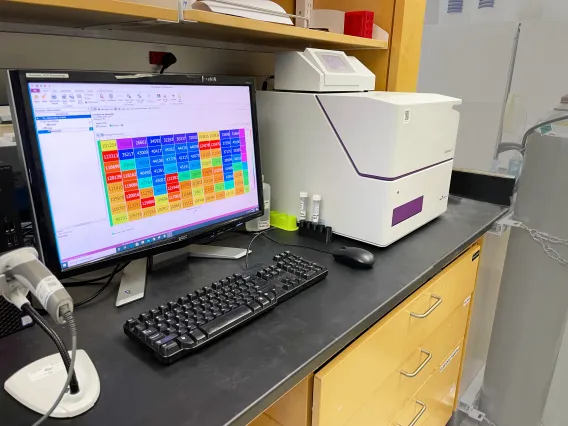
CLARIOstar Plus - plate reader

The CLARIOstar Plus is both the most flexible and sensitive microplate reader on the market. This machine is capable of reading fluorescence, luminescence, and absorbance in 6, 12, 24, 96, or 384-well plates. The CLARIOstar Plus has patented Linear Variable Filters that allow the user to select their ideal wavelengths with the provided and supported software, allowing for excitation and emission reads over multiple wavelengths without hardware manipulations. The CLARIOstar Plus is able to perform modern cell/molecular/high throughput assays including:

  • DNA,RNA and Protein quantification
  • Cell based assay / Long Term Kinetic Live Cell Assays
  • Enzyme and Kinetic assays
  • Reporter gene assays
  • Molecular binding assays
  • ELSIA
  • Fluorescence Polarization
  • Bioluminescent Resonance Energy Transfer (BRET)
  • Time Resolved Fluorescence (TRF)

Reagent Dispenser

Sample Input:

  • Sample preparations in 6, 12, 24, 96, or 384-well plates

Light Sources:

  • High energy xenon flash lamp
  • Dedicated Laser for Alphascreen / AlphaLISA / Alphaplex

Detection Modes:

  • UV/Vis absorbance
  • Fluorescence intensity
  • Luminescence
  • Fluorescence polarization
  • Time-resolved fluorescence
  • TR-FRET
  • Alphascreen / AlphaLISA / Alphaplex

Measurement Modes:

  • Top and bottom reading
  • Endpoint and Kinetic
  • Sequential multi-excitation
  • Sequential multi-emission
  • Spectral scanning (Absorbance, Luminescence, Fluorescence)
  • Ratiometric measurements
  • Well scanning

Spectral Range:

  • LVF Monochromators:
    • Fluorescence: 320-740 nm
    • Luminescence: 320-740 nm
  • Additional Filters:
    • Ex TR
    • LP TR
    • LP 504
    • LP 566
    • LP 601
    • LP 639
    • SP AS
    • 482-16
    • 530-40
    • 540-20
    • 570-100
    • 580-10
    • 590-20
    • 590-50
    • 615-18
    • 620-10
    • 665-10
    • 680-40
    • 875-50
    • Linear Variable Dichroic
      • 340-740nm
  • Spectrometer:
    • ABS:220-1000nm

Plate Selection Recommendations:

  • For luminescence
    • A solid bottom white plate is recommended because it will maximize your signal
  • For fluorescence
    • Black plates reduce background noise
    • A solid bottom black plate is recommended if you will be doing a top read (most assays)
    • A clear bottom black plate is recommended if you will be doing a bottom read of adherent cells (or if you would like to evaluate cell growth prior to the assay)
  • For absorbance
    • A clear bottom plate is required


Facility Email: fgc@arizona.edu

Image
CLARIOstar plus
Equipment
Location